


16th Sunday in Ordinary Time (Year A) - 19 July 2026
19th July 2026
“Let us not be like the path, where the seed is snatched away by the devil; nor like the rocky ground, where the seed cannot take root; nor like the thorny soil, where the seed is choked by worldly concerns. Instead, let us be like the rich soil, where the seed can grow and bear fruit.” - St Augustine
A reflection on today's Gospel taken from an excerpt of the Angelus Address by Pope Benedict XVI at the Courtyard of the Papal Summer Residence, Castel Gandolfo on Sunday, 17 July 2011:
Dear Brothers and Sisters,
The Gospel parables are brief accounts that Jesus uses to proclaim the mysteries of the Kingdom of Heaven. Using imagery from situations of daily life, the Lord “wants to show us the real ground of all things.... He shows us... the God who acts, who intervenes in our lives, and wants to take us by the hand” (Jesus of Nazareth: From the Baptism in the Jordan to the Transfiguration, English edition, Doubleday, 2007, p. 192).
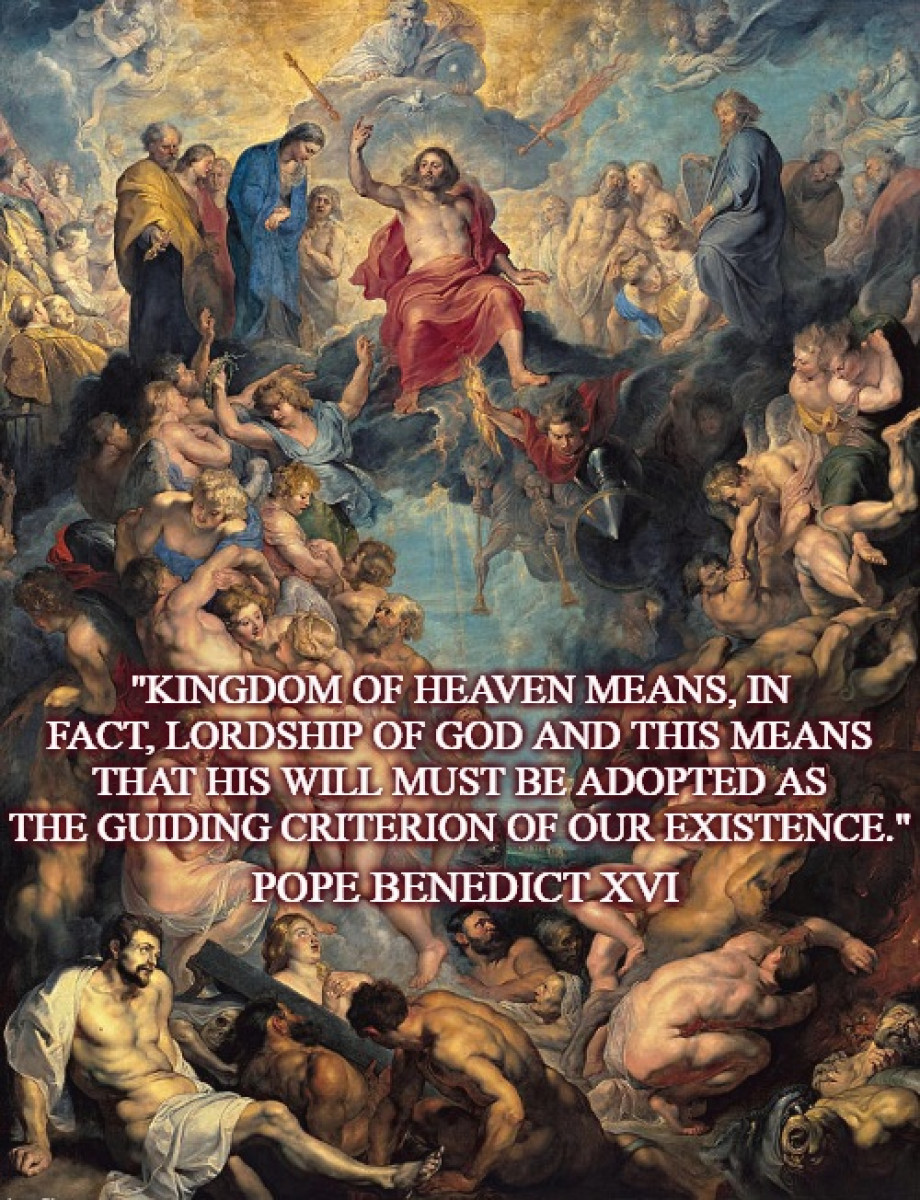
With this kind of discourse the divine Teacher invites us to recognise first of all the primacy of God the Father: Wherever He is absent, nothing can be good. He is a crucial priority for all things. Kingdom of Heaven means, in fact, lordship of God and this means that His will must be adopted as the guiding criterion of our existence.
The subject of this Sunday’s Gospel is, precisely, the Kingdom of Heaven. “Heaven” should not be understood only in the sense that it towers above us, because this infinite space also takes the form of human interiority. Jesus compares the Kingdom of Heaven to a field of wheat to enable us to understand that something small and hidden has been sown within us which, nevertheless, has an irrepressible vital force. In spite of all obstacles, the seed will develop and the fruit will ripen. This fruit will only be good if the terrain of life is cultivated in accordance with the divine will.
For this reason in the Parable of the Weeds [tares] among the good Wheat (Mt 13:24-30) Jesus warns us that, after the owner had scattered the seed, “while men were sleeping, his enemy” intervened and sowed weeds among the wheat. This means that we must be ready to preserve the grace received from the day of our Baptism, continuing to nourish faith in the Lord that prevents evil from taking root. St Augustine commenting on the parable noted “many are at first tares but then become good grain”, and he added: “if these, when they are wicked, are not endured with patience they would not attain their praiseworthy transformation” (Quaest. septend. in Ev. sec. Matth., 12, 4: PL 35, 1371).
Dear friends, the Book of Wisdom — from which today’s First Reading is taken — emphasises this dimension of the divine Being and states: “Neither is there any god besides You, Whose care is for all men.... For Your strength is the source of righteousness, and Your sovereignty over all causes You to spare all” (Wis 12:13, 16). And Psalm 86 [85] confirms it: “You, O Lord, are good and forgiving, abounding in steadfast love to all who call on You” (v. 5).
Hence if we are children of such a great and good Father, let us seek to be like Him! This was the aim Jesus set Himself with His preaching; indeed, He said to those who were listening to Him: “You... must be perfect, as your heavenly Father is perfect” (Mt 5:48). Let us turn with trust to Mary … so that she may help us to follow Jesus faithfully, and so live as true children of God.
A Prayer to Grow in Holiness (St Augustine)
Breathe in me, O Holy Spirit,
that my thoughts may all be holy.
Act in me, O Holy Spirit,
that my work, too, may be holy.
Draw my heart, O Holy Spirit,
that I love but what is holy.
Strengthen me, O Holy Spirit,
to defend all that is holy.
Guard me, then, O Holy Spirit,
that I always may be holy. Amen.
Art Credit: The Great Last Judgement by Peter Paul Rubens (1614 - 1617 AD)