

The Most Holy Body and Blood of Christ / Corpus Christi (Year A) - 7 June 2026
7th June 2026
“Jesus Christ gives Himself entirely to us; He unites His Sacred Body with ours; and, by this union, we become one and the same spirit with Him. As the food which we take nourishes our body, so the Holy Eucharist is the nourishment of our soul. For even as our bodily food is changed into our substance, so the Holy Eucharist transforms us into Jesus Christ.” - St John Baptist de la Salle
An excerpt from the homily given by St Josemaria Escriva on May 28, 1964. The homily is published by Scepter Publishers in the book Christ is Passing By:
Today, on the feast of Corpus Christi, we come together to consider the depths of our Lord’s love for us, which has led Him to stay with us, hidden under the appearances of the blessed Sacrament. It almost seems as if we can physically hear Him teaching the multitude: “A sower went out to sow his seed. And as he sowed, some seeds fell along the path, and the birds came and devoured them. Other seeds fell on rocky ground, where they had not much soil, and immediately they sprang up, since they had no depth of soil, but when the sun rose they were scorched; and since they had no root they withered away. Other seeds fell among thorns, and the thorns grew up and choked them. Other seeds fell on good soil and brought forth grain, some a hundredfold, some sixty, some thirty.”
It is a vivid scene. The divine sower is also sowing His seed today. The work of salvation is still going on, and our Lord wants us to share that work. He wants Christians to open to His love all the paths of the earth. He invites us to spread the divine message, by both teaching and example, to the farthest corners of the earth. He asks us, as citizens of both ecclesial and civil society, to be other Christs by fulfilling our duties conscientiously, sanctifying our everyday work and the responsibilities of our particular walk of life.
If we look around, if we take a look at the world, which we love because it is God’s handiwork, we will find that the parable holds true. The word of Jesus Christ is fruitful, it stirs many souls to dedication and fidelity. The life and conduct of those who serve God have changed history. Even many of those who do not know our Lord are motivated, perhaps unconsciously, by ideals which derive from Christianity.
We can also see that some of the seed falls on barren ground or among thorns and thistles; some hearts close themselves to the light of faith. Ideals of peace, reconciliation and brotherhood are widely accepted and proclaimed, but all too often the facts belie them. Some people are futilely bent on smothering God’s voice. To drown it out they use brute force or a method which is more subtle but perhaps more cruel because it drugs the spirit, indifference.
When thinking about all this, I should like us to take stock of our mission as Christians. Let’s turn our eyes to the Holy Eucharist, toward Jesus. He is here with us, He has made us a part of Himself: “Now you are the body of Christ and individually members of it.” God has decided to stay in the tabernacle to nourish us, strengthen us, make us divine and give effectiveness to our work and efforts. Jesus is at one and the same time the sower, the seed and the final result of the sowing: the bread of eternal life.
The miracle of the holy Eucharist is being continually renewed and it has all Jesus’ personal traits. Perfect God and perfect man, Lord of heaven and earth, He offers Himself to us as nourishment in the most natural and ordinary way. Love has been awaiting us for almost two thousand years. That’s a long time and yet it’s not, for when you are in love time flies.
I remember a lovely poem, one of the songs collected by Alfonso X the Wise. It’s a legend about a simple monk who begged our Lady to let him see heaven, even if only for a moment. Our Lady granted him his wish and the good monk found himself in paradise. When he returned, he could not recognise the monastery — his prayer, which he had thought very short, lasted three centuries. Three centuries are nothing to a person in love. That’s how I explain Christ waiting in the Eucharist. It is God waiting for us, God Who loves man, Who searches us out, Who loves us just as we are — limited, selfish, inconstant, but capable of discovering His infinite affection and of giving ourselves fully to Him.
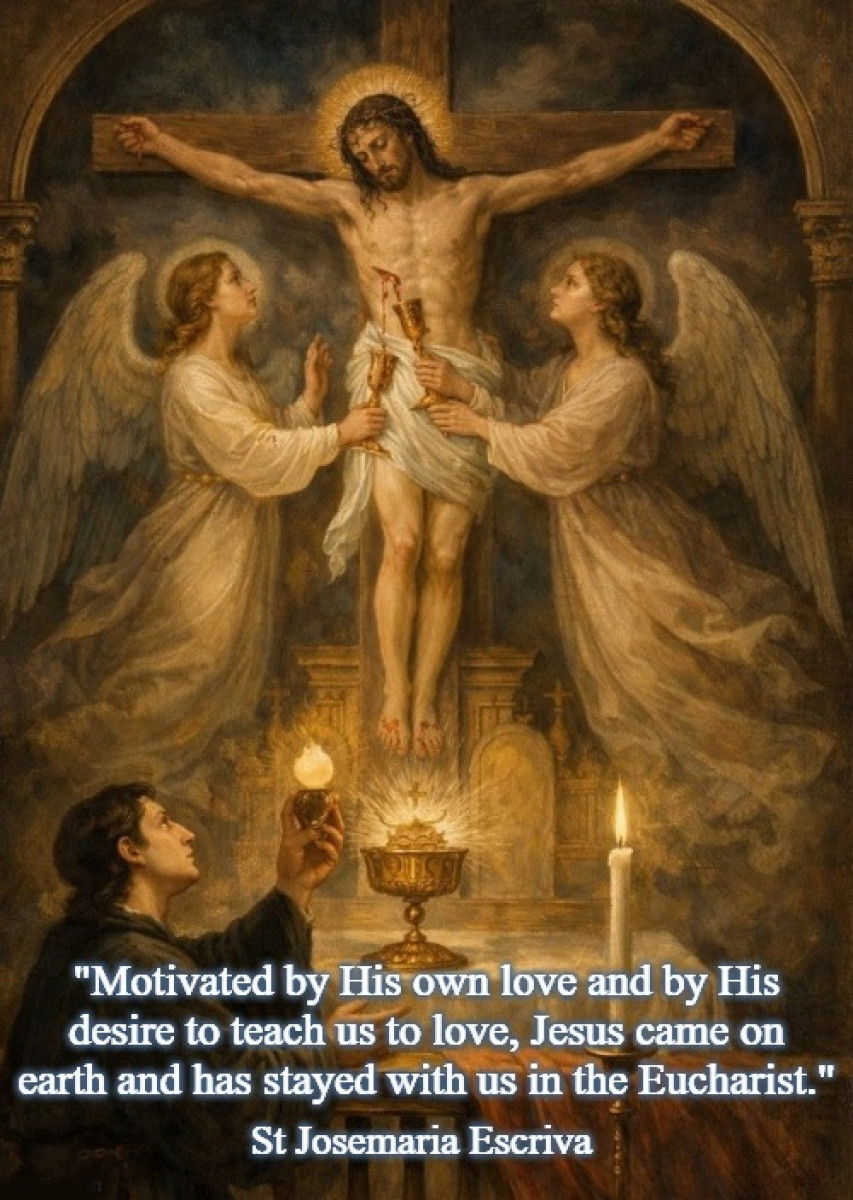
Motivated by His own love and by His desire to teach us to love, Jesus came on earth and has stayed with us in the Eucharist. “Having loved His own who were in the world, He loved them to the end”: that’s how St John begins his account of what happened on the eve of the passover when Jesus “took bread and after He had given thanks, broke it, and said, This is My body which is given up for you. Do this in remembrance of me. In the same way also the cup, after supper, saying: This is the new covenant in My blood. Do this, as often as you drink it, in remembrance of Me.”
Anima Christi Prayer
Soul of Christ, sanctify me.
Body of Christ, save me.
Blood of Christ, inebriate me.
Water from the side of Christ, wash me.
Passion of Christ, strengthen me.
O Good Jesus, hear me.
Within Thy wounds hide me.
Never let me be separated from Thee.
From the malignant enemy defend me.
At the hour of my death, call me; and bid me come to Thee.
That with Thy saints and angels, I may praise Thee for all eternity. Amen.
Corpus Christi
The great Feast of Corpus Christi is a yearly reminder of how we should treat this beautiful and awesome sacrament. Some important points to remember:
1. the presence of Christ in the Blessed Sacrament is unique and raises the Eucharist above all the other sacraments.
2. the Eucharistic presence of Christ begins at the moment of consecration and endures as along as the Eucharistic species subsists; and so prayer after Holy Communion is important.
3. genuflection (going down on the right knee) is the way to show honour and respect to the presence of Christ; bowing is done to the crucifix, statues, and relics.
4. a double genuflection (going down on both knees) is the way to show honour and respect to the Blessed Sacrament when exposed in the monstrance.
when passing in front of the tabernacle from one side of the church to the other, a genuflection is required.
5. only a baptised Catholic in the state of grace may receive Holy Communion; one who is conscious of grave sin should not receive without going to sacramental confession.
6. a fast from food and drink (except water and medicine) for one hour is required before receiving Holy Communion
7. the reception of Holy Communion kneeling and on the tongue is a right given to each of the faithful both by law as well as by tradition.
8. the reception of Holy Communion standing and on the hand is an exception granted by the permission of the Apostolic See (i.e. the Pope).
9. any Catholic who is not prevented by law must be admitted to Holy Communion.
10. non-Catholics and non-Christians may not be admitted to Holy Communion.
11. Catholics should receive Holy Communion at the Mass they attend, and should do so at least once a year between Easter and Pentecost.
12. permission is granted to receive Holy Communion twice on the same day when attending another Mass e.g. a funeral
13. it is recommended that exposition of the Blessed Sacrament take place in churches for an appropriate time at least once a year or more often.