
Laetare Sunday / 4th Sunday of Lent (Year A) - 15 March 2026
15th March 2026
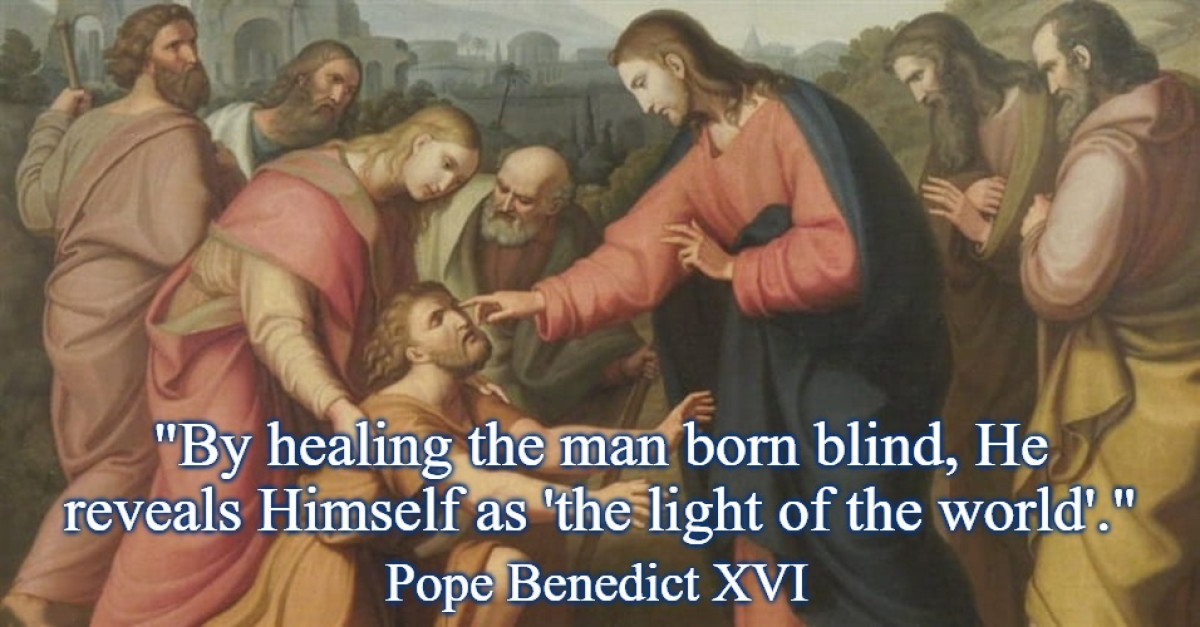
“We must trust in the mighty power of God’s mercy. We are all sinners, but His grace transforms us and makes us new.” - Pope Benedict XVI
Laetare Sunday
The fourth Sunday of Lent marks the halfway point of our preparation for Easter and is celebrated with rose vestments instead of the usual violet. Laetare means “to rejoice” in Latin, and the lighter vestments signify a brief celebration in expectation of Easter, even in the midst of Lent.
Reflection
An excerpt of the Angelus Address of Pope Benedict XVI at St Peter’s Square, Fourth Sunday of Lent, 2 March 2008:
On these Sundays in Lent the liturgy takes us on a true and proper baptismal route through the texts of John’s Gospel: last Sunday, Jesus promised the gift of “living water” to the Samaritan woman; today, by healing the man born blind, he reveals himself as “the light of the world”; next Sunday, in raising his friend Lazarus, he will present himself as “the resurrection and the life”. Water, light and life are symbols of Baptism, the Sacrament that “immerses” believers in the mystery of the death and Resurrection of Christ, liberating them from the slavery of sin and giving them eternal life.
Let us reflect briefly on the account of the man born blind (Jn 9: 1-41). According to the common mentality of the time, the disciples take it for granted that his blindness was the result of a sin committed by him or his parents. Jesus, however, rejects this prejudice and says: “It was not that this man sinned, or his parents, but that the works of God might be made manifest in him” (Jn 9: 3).
What comfort these words offer us! They let us hear the living voice of God, who is provident and wise Love! In the face of men and women marked by limitations and suffering, Jesus did not think of their possible guilt but rather of the will of God who created man for life. And so he solemnly declares: “We must work the works of him who sent me.... As long as I am in the world, I am the light of the world” (Jn 9: 5).
And he immediately takes action: mixing a little earth with saliva he made mud and spread it on the eyes of the blind man. This act alludes to the creation of man, which the Bible recounts using the symbol of dust from the ground, fashioned and enlivened by God’s breath (Gn 2: 7). In fact, “Adam” means “ground” and the human body was in effect formed of particles of soil. By healing the blind man Jesus worked a new creation.
But this healing sparked heated debate because Jesus did it on the Sabbath, thereby in the Pharisees’ opinion violating the feast-day precept. Thus, at the end of the account, Jesus and the blind man are both cast out, the former because he broke the law and the latter because, despite being healed, he remained marked as a sinner from birth.
Jesus reveals to the blind man whom he had healed that he had come into the world for judgement, to separate the blind who can be healed from those who do not allow themselves to be healed because they consider themselves healthy. Indeed, the temptation to build himself an ideological security system is strong in man: even religion can become an element of this system, as can atheism or secularism, but in letting this happen one is blinded by one’s own selfishness.
Dear brothers and sisters, let us allow ourselves to be healed by Jesus, who can and wants to give us God’s light! Let us confess our blindness, our shortsightedness, and especially what the Bible calls the “great transgression” (see Ps 19[18]: 13): pride. May Mary Most Holy, who by conceiving Christ in the flesh gave the world the true light, help us to do this.
Prayer for Christlikeness (St John Henry Newman)
Dear Jesus, help me to spread Your fragrance everywhere I go; Flood my soul with Your spirit and life; Penetrate and possess my whole being so completely that all my life may be only a radiance of Yours; Shine through me and be so in me that everyone with whom I come into contact may feel Your presence within me. Let them look up and see no longer me—but only Jesus. Amen.